Quick Answer
Most Trinidad businesses should build for both platforms simultaneously using a cross-platform framework like Flutter, which cuts development costs by up to 50%.
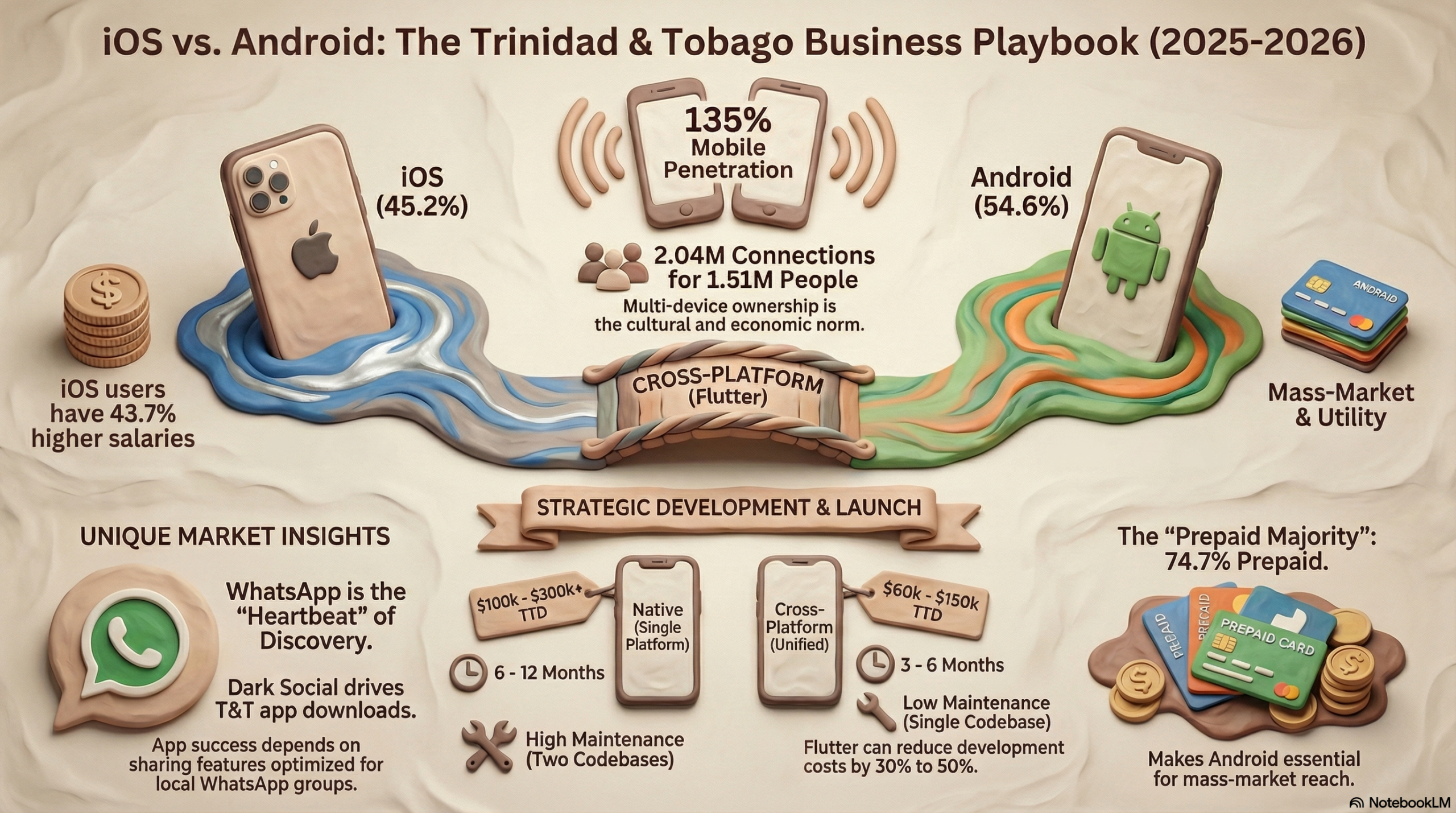
Android holds 54.6% of Trinidad’s mobile market and iOS holds 45.18% — near parity. Launching on only one platform means ignoring almost half your potential customers. Cross-platform development lets you ship to both from a single codebase for $60,000–$150,000 TTD, compared to $100,000–$300,000+ TTD per platform going native. If budget forces a choice, pick based on your customer: iOS for premium, high-spend users; Android for mass-market reach and the 74.7% prepaid majority.
How Big Is Trinidad’s Mobile Market in 2026?
Trinidad and Tobago punches above its weight. The country has 1.51 million people but 2.04 million active mobile connections — a 135% penetration rate. That means multi-device ownership and dual-SIM usage are standard, not exceptions.
The infrastructure backs it up. TATT’s 2023 Annual Market Report shows mobile data traffic grew 18.4% in a single year, hitting 98.2 petabytes. Voice traffic actually declined 5.6% — Trinis are using data, not minutes. And 98.2% of all mobile connections now run on 3G, 4G, or 5G broadband networks, with median mobile speeds at 29.49 Mbps.
For business owners, the takeaway is direct: mobile is the primary commerce interface in Trinidad. Not a secondary channel. Not a “nice to have.” The market generates approximately $2.1 billion TTD annually in mobile service revenue alone.
| Digital Indicator | Value (2025/2026) |
|---|---|
| Total Population | 1.51 Million |
| Active Mobile Connections | 2.04 Million |
| Mobile Connection Penetration | 135% |
| Internet Penetration Rate | 84.7% |
| Total Mobile Data Traffic | 98.2 Petabytes |
| Broadband Mobile Connections | 98.2% |
What Is the iOS vs Android Market Share in Trinidad?
Globally, Android dominates with 70%+ market share. Trinidad tells a different story.
In 2022, Android held 62.62% and iOS had 37.1%. By 2026, that gap has tightened to Android 54.6% vs iOS 45.18%. That near-parity is the single most important data point for your platform decision.
Samsung and Apple together control nearly 90% of all devices in the country — Samsung at 51.55%, Apple at 37.1%. Niche brands like Xiaomi (2.1%), Motorola (0.85%), and Google (0.8%) barely register. That simplifies your testing matrix significantly: you only need to optimize for two manufacturers.
The pricing gap tells you who uses what. Through Digicel and bmobile, an iPhone 16 Pro Max runs approximately $4,100 TTD. A Samsung Galaxy S25 Ultra sits at $3,660 TTD. But Android’s floor starts at $200–$300 TTD with devices like the Xiaomi Redmi A4 5G. That price flexibility is why Android dominates the mass market while iOS concentrates higher-income users.
| Mobile OS | 2022 Share | 2026 Share | Trend |
|---|---|---|---|
| Android | 62.62% | 54.60% | Declining |
| iOS | 37.10% | 45.18% | Increasing |
| Other | 0.28% | 0.22% | Negligible |
Who Uses iOS vs Android in Trinidad — and Why Does It Matter?
Platform choice is a proxy for purchasing power. Globally, iPhone users earn approximately 43.7% more than Android users. In Trinidad, where import duties and currency fluctuations make a flagship iPhone a serious investment, owning one signals upper-middle to upper-class purchasing power.
The spending gap extends to apps. Despite Android’s larger global user base, the Apple App Store generated $89 billion in consumer spending in 2024, versus $59 billion on Google Play. iOS users also spend roughly nine more hours per month in their apps and engage more with in-app purchases and subscriptions.
If your revenue model depends on high-value transactions — luxury retail, private banking, premium subscriptions — iOS gives you a concentrated pool of high-value leads.
Android is the platform of reach. TATT data shows 74.7% of all mobile subscriptions in Trinidad are prepaid, representing approximately 1.6 million users. These users run on affordable Android handsets with flexible data plans from Digicel and bmobile. If you’re building essential services, mass-market retail, or government-to-citizen (G2C) tools, Android is non-negotiable.
Design implications: An Android app for the T&T market should prioritize efficiency, low data consumption, and straightforward utility. An iOS app should lean into seamless design, polished animations, and high-trust security protocols.
| Attribute | iOS User | Android User |
|---|---|---|
| Average Income | High (+43.7% vs Android) | Moderate to Low |
| Spending Habits | High In-App Spend | Price-Sensitive / Utility-Focused |
| Daily Engagement | ~5 Hours | ~3.7 Hours |
| T&T Market Share | ~45% | ~55% |
| Subscription Type | Likely Postpaid / High Data | 74.7% Prepaid Majority |
How Much Does It Cost to Build for Each Platform in Trinidad?
The local market for mobile app developers is competitive. The average gross salary for a mobile developer in Trinidad is approximately $182,316 TTD per year ($88 TTD/hour). Entry-level developers start around $129,639 TTD, while senior developers with 8+ years command over $206,134 TTD.
The fundamental cost question is native vs cross-platform.
Native development means separate teams and codebases — Swift or Objective-C for iOS, Kotlin or Java for Android. You get the best possible performance and hardware integration, but you’re essentially paying for two apps.
Cross-platform frameworks like Flutter (Google) or React Native (Meta) let one team build for both platforms from a single codebase. Flutter has become particularly popular in the Caribbean thanks to Hot Reload and its Impeller rendering engine, which delivers near-native performance.
| Metric | Native (Single Platform) | Cross-Platform (Both) |
|---|---|---|
| Initial Cost (TTD) | $100,000–$300,000+ | $60,000–$150,000 |
| Development Time | 6–12 Months | 3–6 Months |
| Performance | Excellent | Good to Excellent |
| Maintenance | High (Two Codebases) | Low (Single Codebase) |
For a detailed breakdown of what drives these costs — from UI complexity to backend infrastructure — see our full mobile app pricing breakdown for Trinidad.
For most SMEs and startups, cross-platform is the clear winner. Native still makes sense for performance-critical apps — high-end gaming, complex financial trading, or advanced AR/VR.
What Payment Options Can You Integrate in Trinidad?
A business app that can’t process payments is a brochure. The good news: Trinidad’s fintech landscape has matured.
WiPay operates across 12 Caribbean territories and is the region’s dominant payment gateway. It’s PCI-compliant, works on both iOS and Android, and its Scan 2 Pay QR technology enables contactless payments without physical cards.
Republic EPay from Republic Bank lets businesses accept Visa and MasterCard credit and international debit cards, with dedicated technical support for custom app integrations.
Endcash, also backed by Republic Bank, is a mobile wallet where users top up via local credit cards and pay merchants through QR codes. Integration with other financial institutions is still limited, but the user-facing experience is solid.
The biggest recent development: First Citizens Bank launched Google Pay on December 3, 2025. Android users can now link FCB credit or prepaid cards for contactless payments in stores and online. For any business building on Android, integrating Google Pay as a checkout option reduces friction and cart abandonment significantly.
| Payment Solution | Platform | Key Feature |
|---|---|---|
| WiPay | iOS / Android | Regional ubiquity; QR payments |
| Google Pay | Android (FCB) | Contactless; App/Web checkout |
| Endcash | iOS / Android | Social wallet; QR shopping |
| Republic EPay | Web / App | Native Visa/MasterCard gateway |
| Apple Pay | iOS | Limited local bank support |
What Do You Need to Publish on the App Store and Play Store?
Both platforms require registration and compliance steps that can delay your launch if you don’t handle them early.
Google Play Console: One-time $25 USD fee. Trinidad and Tobago is a supported location for merchant registration, and payouts deposit directly into local bank accounts via wire transfer.
Apple Developer Program: $99 USD annual fee. Identity verification is strict — government-issued photo ID required. Organizations must obtain a D-U-N-S Number from Dun & Bradstreet before Apple will approve enrollment. The D-U-N-S application is free but can add weeks to your timeline.
Both platforms require detailed privacy policies disclosing how you handle financial data, contacts, and identifiers. Trinidad businesses selling digital products through either store should file Form W-8BEN to certify foreign status and potentially reduce US withholding tax — T&T has Double Taxation Treaties with the USA, Canada, and the UK through the Ministry of Finance.
How Should You Market Your App in Trinidad?
App discovery in Trinidad operates on different rules than larger markets. WhatsApp is not just a messaging app here — it’s the primary engine for what marketers call “Dark Social.” Campaigns spread through voice notes, memes, and direct links in private group chats. If your app doesn’t generate content worth sharing on WhatsApp, it won’t scale locally.
Facebook remains dominant for community engagement (784k users in T&T). Instagram Reels and TikTok have captured the younger demographics — short-form video is the fastest way to grab attention. Focus on “save-worthy” content: local guides, tutorials, behind-the-scenes stories.
Micro-influencers who reflect genuine Caribbean identity outperform global celebrities in this market. Authenticity drives downloads. Partner with local creators, not imported endorsements.
So Which Platform Should You Build First?
It depends on three things: your target customer, your revenue model, and your budget.
Build iOS first if you’re targeting high-net-worth individuals, urban professionals, or premium services. iOS users earn more, spend more in apps, and engage longer.
Build Android first if you need mass reach, target prepaid users, or provide essential/public services. Android is the only way to reach the 74.7% prepaid majority on affordable handsets. Google Pay via First Citizens Bank strengthens this case further.
Build both with Flutter if you’re a startup or SME — and most Trinidad businesses are. The 55/45 market split means a single-platform launch alienates nearly half your audience. Cross-platform development cuts costs by up to 50% while delivering native-like performance. This is the path mobile app developers in Trinidad recommend for the majority of local projects.
The mobile market in Trinidad is too split and too active to ignore either side. Match your platform to your customer, keep your costs lean, and build for the audience that’s already in their phones five hours a day.